What Is Partial Knee Replacement?
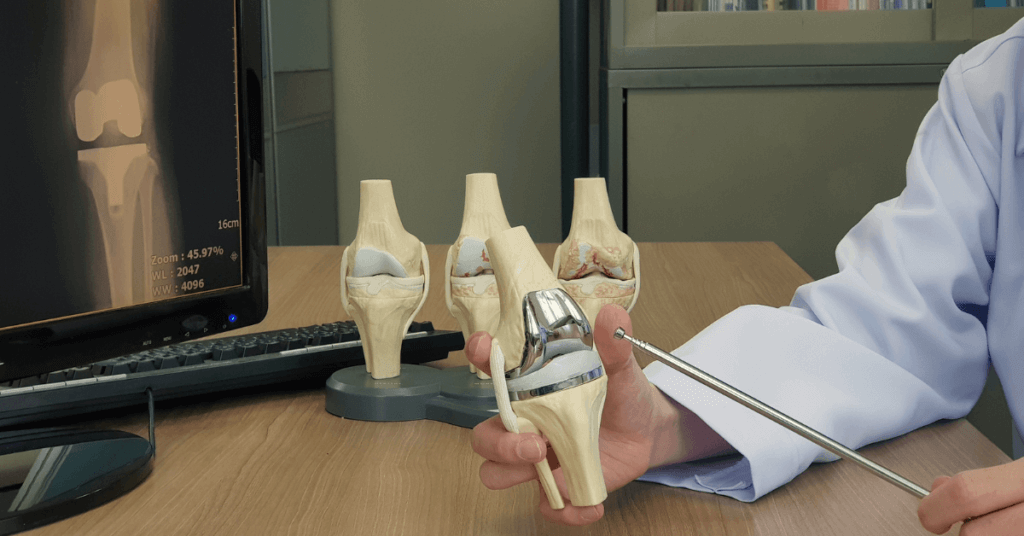
Partial knee replacement (UKA) replaces only the damaged portion of the knee—usually the medial, lateral, or patellofemoral compartment—while preserving healthy bone, cartilage, and cruciate ligaments. Joint Robo’s robotic arm translates preoperative CT scans into sub-millimetre accuracy so implants match your native anatomy and maintain natural knee feel.
Partial Knee Implant Options
- Medial Compartment Replacement: Addresses isolated inner knee arthritis while preserving lateral cartilage and ligaments.
- Lateral Compartment Replacement: Ideal for valgus deformity or cartilage wear on the outer side of the joint.
- Patellofemoral Replacement: Resurfaces the kneecap and trochlea for patients with anterior knee pain or dysplasia.
Who Benefits From Partial Knee Replacement?
UKA is recommended for people with compartment-specific osteoarthritis who still have good range of motion, strong ligaments, and limited deformity. It’s particularly valuable for active adults who want to return to low-impact sport without the stiffness often felt after total knee replacement.
- Isolated medial or lateral arthritis: Pain localised to one side of the joint with intact opposite cartilage.
- Post-meniscectomy degeneration: Progressive wear after prior meniscus removal but stable ligaments.
- Patellofemoral disease: Persistent anterior knee pain from maltracking or cartilage loss.
- Young, active patients: Individuals seeking a bone-preserving option with easier future revision if needed.
A comprehensive clinical exam, stress X-rays, and CT-based planning confirm candidacy and ensure balanced soft tissues before surgery.
The Partial Knee Procedure
Joint Robo follows a ligament-sparing, robotic-assisted workflow designed to deliver predictable outcomes with minimal tissue disruption.
- Preoperative mapping: High-resolution CT scans create a three-dimensional model of your knee, highlighting the targeted compartment.
- Precision exposure: A small incision is made over the affected side while cruciate ligaments and healthy cartilage remain untouched.
- Robotic resurfacing: The automatic arm guides bone preparation to match implant size, slope, and rotation exactly to the plan.
- Component balancing: Soft tissues are assessed in flexion and extension to confirm smooth movement before closure.
Advantages of Partial Knee Replacement
- Natural knee mechanics: Preserving cruciate ligaments maintains proprioception and coordination.
- Smaller incision: Less disruption means lower blood loss and quicker return to daily tasks.
- Faster recovery: Most patients walk with support the same day and resume office work in 2 to 3 weeks.
- Simplified revisions: If progression occurs, conversion to total knee replacement remains straightforward.
Recovery Milestones
- Day 0–1: Early mobilisation with walker support, ankle pumps, and quad activation exercises.
- Week 2–4: Progress to full weight-bearing, stationary cycling, and proprioceptive drills.
- Week 6–8: Return to driving, desk work, and controlled recreational activities.
- Month 3+: Graduated jogging, doubles tennis, and low-impact sports after surgeon clearance.
- Long-term: Annual reviews ensure implant stability and reinforce joint protection strategies.
Risks and Considerations
Partial knee replacement has an excellent safety profile, yet informed consent is essential.
- Disease progression: Arthritis can advance to other compartments, occasionally necessitating total replacement.
- Implant loosening: Rare but possible, especially with high-impact activities or poor bone quality.
- Stiffness: Limited motion may occur without consistent physiotherapy.
- Infection or clot formation: Prevented with sterile technique, antibiotics, compression, and mobilisation.
- Nerve or vessel irritation: Meticulous dissection and robotic guidance minimise these risks.
Rigorous prehabilitation, optimised nutrition, and adherence to post-op protocols keep complication rates extremely low at Joint Robo.